
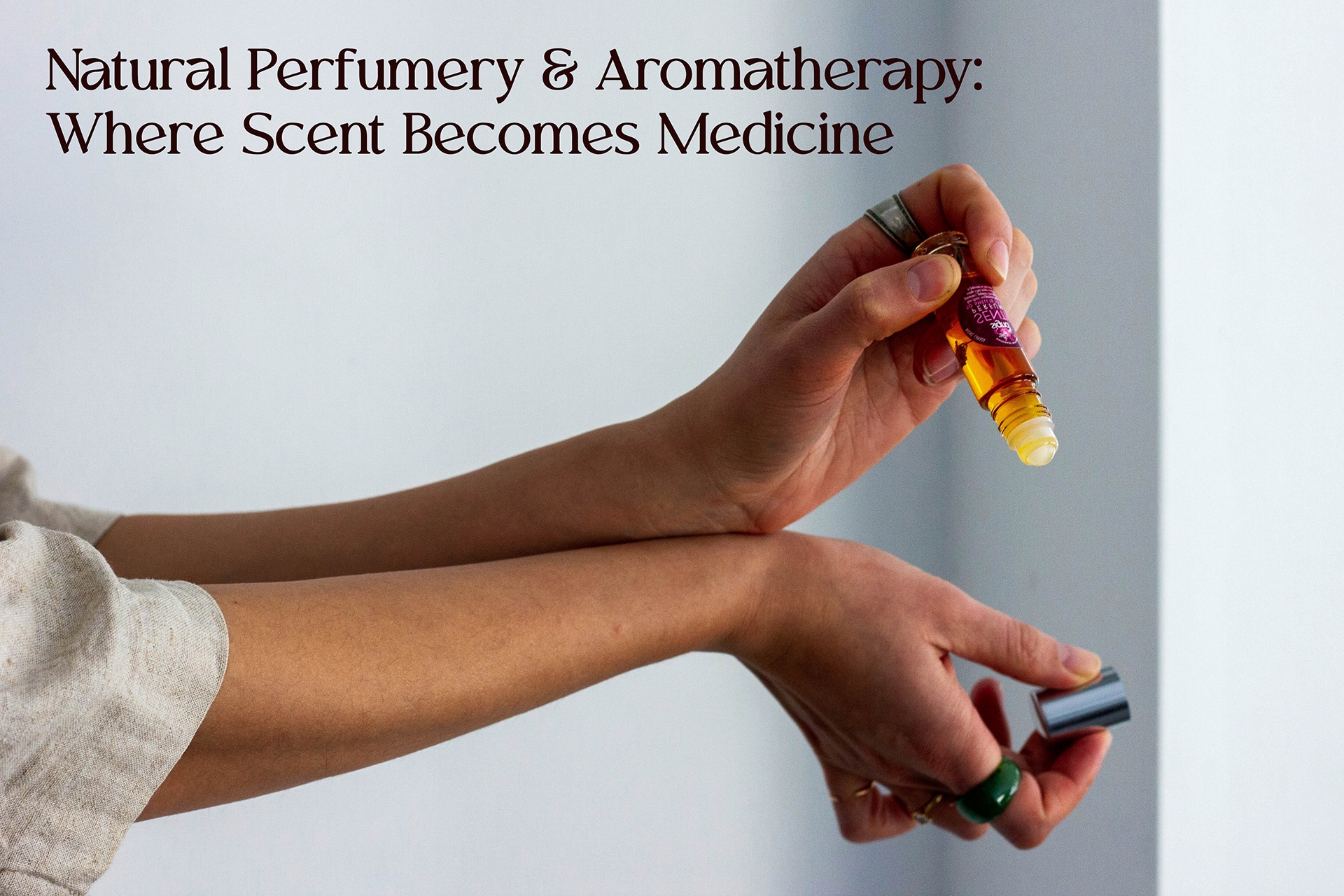

Long before scent was bottled, branded, or adulterated, it was burned, worn, prayed with, and brewed into medicine. Across cultures and centuries, aromatic plants have lived at the crossroads of beauty and healing, ritual and emotion, devotion and daily life.
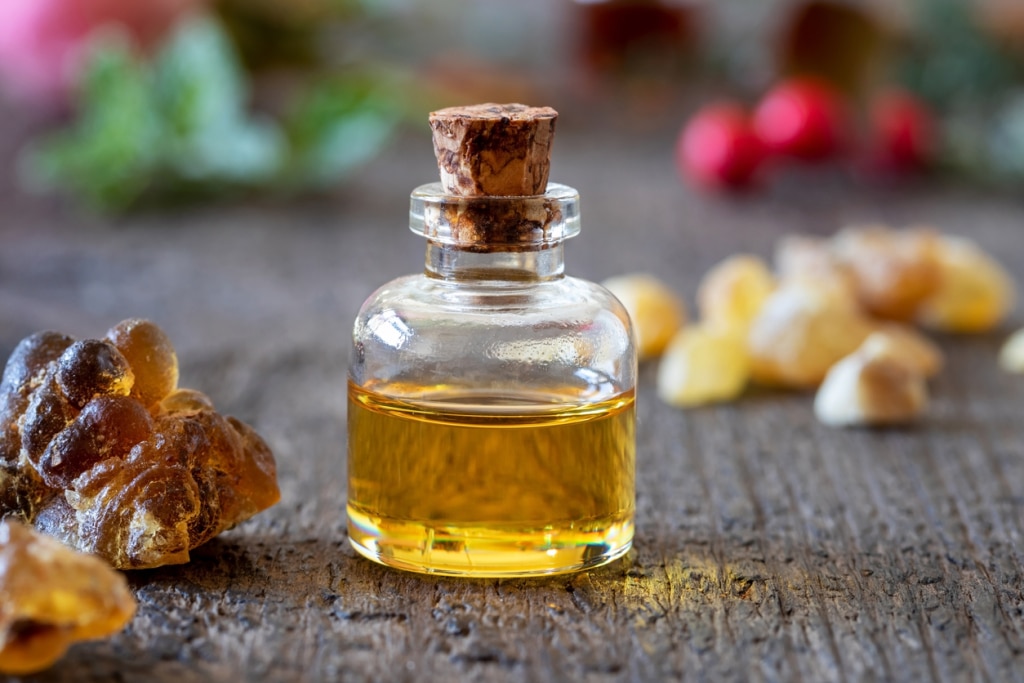
Ancient temples burned Frankincense as both offering and antiseptic. Egyptian priests formulated Kyphi incense to honor the gods and ease the mind into sleep. Medieval monasteries used distilled Rose water for prayer and wound care. Scent was never just one thing – it was always beauty and medicine, devotion and pragmatism, emotional and physical.
Before extracted essential oils existed, incense was both the original form of aromatherapy and the original form of perfumery. In many spiritual traditions, burning incense was understood as a form of prayer itself, fragrant smoke rising as a bridge between the physical and spiritual realms. This reverence is carried in the very word perfume, from the Latin per fumum, meaning “through smoke.” In some ancient cultures, the words for perfume and incense were interchangeable, reflecting a time when scent had not yet been divided into categories.
Perfume, then, was not just a luxury, but a sacred art, a means of purification, protection, and communion with the divine. In Ancient Egypt, aromatic oils were woven into daily life, religious ceremony, and burial rites. Scents were believed to enhance beauty, preserve health, and guide the soul into the afterlife. Perfumed linens wrapped the dead, and vessels of fragrant oils were placed in tombs to accompany pharaohs beyond the threshold of this world.
Yet somewhere along the way, modern culture drew a line through the middle of this ancient aromatic tradition. On one side: aromatherapy, the functional, therapeutic application of plant essences for healing. On the other: perfumery, seen as aesthetic, luxurious, or expressive – sometimes even dismissed as indulgent or vain. One became clinical, the other cosmetic. One earned respect, the other raised eyebrows among healers.
But what if that division was never meant to be? What if natural perfumery and aromatherapy are simply two expressions of the same ancient aromatic plants – one speaking in poetry, the other in physiology? And together, they offer a fuller vocabulary for the beautiful healing potential of scent. In this article, we’ll explore this idea and journey through the realms of natural perfumery and aromatherapy, examining their differences, their shared roots, and the ways they deepen and enrich one another.
Aromatherapy vs. Natural Perfumery
Aromatherapy and natural perfumery are two distinct – yet deeply related – aromatic arts. Both work with the same natural materials, but they approach them with different primary intentions.
Aromatherapy is defined as the therapeutic use of aromatic plant constituents to support physical, emotional, and energetic well-being. It's rooted in the understanding that the volatile compounds within essential oils, absolutes, and CO₂ extracts can influence our bodies and minds in measurable ways: calming the nervous system, easing inflammation, supporting respiratory function, shifting mood states, and promoting overall balance.
The emphasis here is on function. Aromatherapy speaks the language of constituent chemistry, therapeutic properties, and clinical application. It asks: What does the body need, and how can plant chemistry support that need?
Natural perfumery, by contrast, is the art of creating scent compositions using only natural aromatic materials – the same essential oils, absolutes, resins, and extracts that aromatherapists work with, but arranged with a different intent. Its focus is artistic, soulful, emotional, and experiential. Natural perfumery is concerned with harmony and movement: how a scent unfolds over time, lingers on the skin, tells a story, and evokes a feeling.
Natural perfumers think in terms of scent architecture: top notes that greet you first then fade, heart notes that weave together the aromatic tapestry, base notes that anchor and endure throughout the day. Perfumers consider beauty, mood, intuition, and ritual. They ask: What story does this scent tell? How does it make you feel? (If you're still wondering – what is natural perfume? – check out our video blog, From Nature to Nose: Unveiling the Art of Natural Perfumery.)

Key Differences
The primary difference between these two aromatic practices lies in their objective. Aromatherapy focuses on function – the therapeutic action of aromatic compounds on the body and psyche – while natural perfumery focuses on artistic intent and impact, the creation of beauty, the evocation of memory, and the expression of something that words cannot quite capture.
While many of the same plants appear in both worlds (like Jasmine, Rose, Agarwood, Frankincense, Sweet Orange, Lavender, Sandalwood, and so on), the perfumer's palette is broader. Many aromatic plants and materials that rarely appear in aromatherapy formulas – mosses, fruits, animalic notes, delicate florals, and more – are treasured in perfumery for their complex, evocative qualities. The perfumer is free to work with materials purely for their aromatic profile, not their therapeutic qualities.
Key Similarities
Yet for all their differences, these practices share profound common ground. Both aromatherapy and natural perfumery use the same foundational materials, the aromatic essences of living plants: essential oils, absolutes, CO₂ extracts, and resins. Both work through the olfactory system as their primary gateway, the ancient neural pathway that bypasses conscious thought and speaks directly to our limbic brain, the seat of emotion and memory.
And perhaps most importantly, both influence mood, the nervous system, emotional state, energy, and spirit. Both rely on scent perception and the subtle physiological and emotional shifts that arise when particular molecules meet receptors in the nose and brain. The Rose that calms stress and anxiety in an aromatherapy blend is the same Rose that evokes beauty and comfort in a natural perfume. The plant doesn't know the difference. Our body doesn't either. We're impacted in the same way regardless of the intention of use.
Unlock Your Free Issue Of...
🌿 The Aromatic Medicine Garden Membership 🌿
Are you ready for a deeper, holistic dive into the world of aromatic plants? See what our membership is all about with your free sneak peek issue, including an hour-long plant talk and a 21-page plant profile pdf full of recipes and insights.

The Problem with Modern Perfume (And Why It Matters)
To understand why natural perfumery matters for those of us passionate about plant-based, holistic health, we need to look at what happened to perfume in the 20th century. The rise of synthetic fragrances revolutionized the perfumery industry, making scents cheaper, more stable, and infinitely reproducible. But this convenience came at a cost.
A growing body of research has linked synthetic fragrance compounds to endocrine disruption, allergic reactions, respiratory irritation, and other health concerns [1]. And because modern perfumes are protected by trade-secret laws, hundreds of individual chemicals can be concealed behind a single word on an ingredient label: “fragrance.” This lack of transparency means that most people have no real way of knowing what they’re breathing in each day, or how it may be affecting their bodies, homes, or the living world around them.
Natural perfumery offers a different reality: pure natural ingredients and scents that carry not just aroma but the therapeutic benefits of real, whole plants. It's a choice rooted in health, wellness, and ethics – not just aesthetics. It’s a return to the natural roots of aromatic arts and the pure essence of aromatic plants – the way it was always meant to be. (You can learn more about the history of natural perfume in our blog post: Poetry in a Bottle.)
Pleasure, Beauty, and Enjoyment Are Therapeutic
Something we often don’t talk about in aromatherapy is the concept that pleasure itself is medicine. When you encounter a scent that brings genuine joy – whether it's the smell of rain on earth; bread baking in the oven; Pine in fresh, forest air; or your grandmother's perfume – your nervous system responds. The body shifts out of a stress response and into a state of safety and ease. This is a form of medicine.
We see this in research on forest bathing, on the comforting power of familiar scents, and on how pleasant aromas regulate the autonomic nervous system. If something reliably brings the body into a state of ease, that is a form of medicine. Beauty and pleasure are not separate from healing. They’re a pathway into it.
This is where natural perfumery becomes a powerful ally to aromatherapy: it reminds us that remedies can – and perhaps should – be beautiful. That healing can be sensorial. And those remedies that bring joy are what we instinctively return to, again and again.
Understanding Scent Formulation
Whether you identify as a perfumer or not, learning the foundations of scent formulation opens a doorway to creativity in your herbal and aromatic remedies. You begin to understand how scents interact: which ones amplify each other, which ones clash, and which ones disappear too quickly or linger too long. You learn to balance intensity, volatility, and harmony. You discover how aroma affects mood, perception, and behavior in ways that go beyond any single oil's therapeutic properties.
And maybe most importantly, you learn to make remedies that weave together both function and beauty. And when something smells good, we reach for it more often. Healing becomes embodied, pleasurable, and woven into daily life. These skills can translate across everything you make: infused oils, salves, soaps, essential oil blends, lotions, candles, incense, ritual blends, beauty products, and more. Instead of just using a single essential oil to scent your herbal or aromatic preparations, you’ll begin to work with a whole palette of aromatics with confident skill and intuitive exploration combined.
In our next article, we’ll explore one of the foundational tools of formulation: top, heart, and base notes, and how they shape both scent and experience.
The Power of Natural Perfume: Art + Chemistry
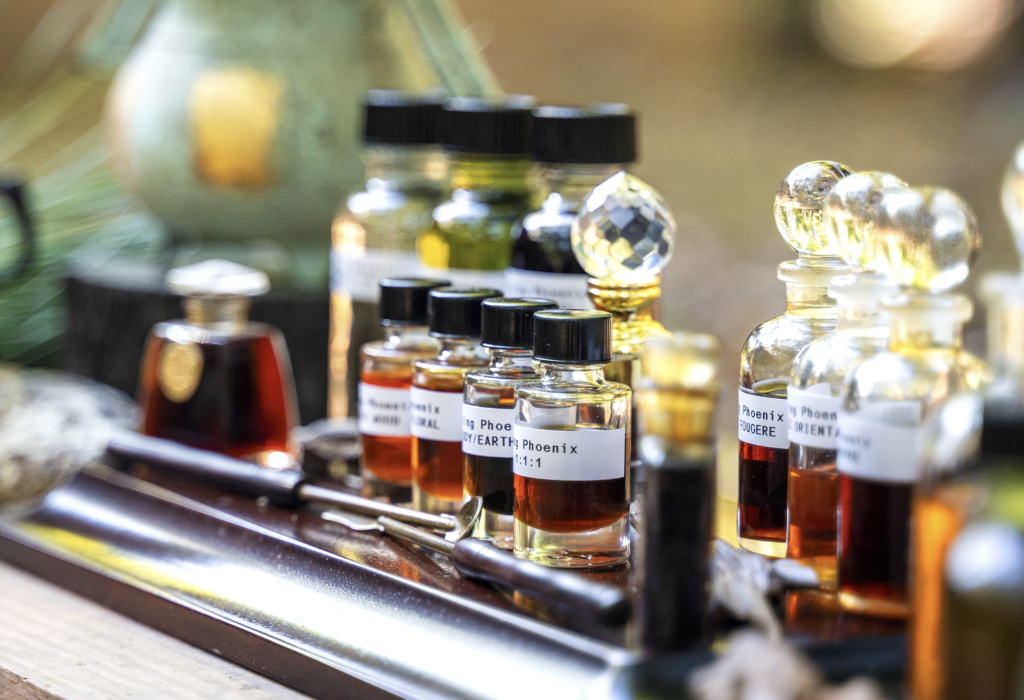
Natural perfumery lives at the meeting point of art and science. It blends the intuitive, expressive language of scent with the physiological wisdom of aromatherapy. Scent has never belonged to a single lane. It has always spoken simultaneously to the body, the heart, and the psyche. For healers, home herbalists, and aromatherapists, natural perfumery is an opportunity to blend beauty, art, and healing. And when healing smells beautiful, it becomes something we want to return to.
For many of us, natural perfumery is a doorway into a deepening of plant relationship, an expansion of our healing vocabulary, and an invitation to bring more beauty into the work of tending body, heart, and spirit. The plants don't distinguish between medicine and art. Perhaps we don't need to either.
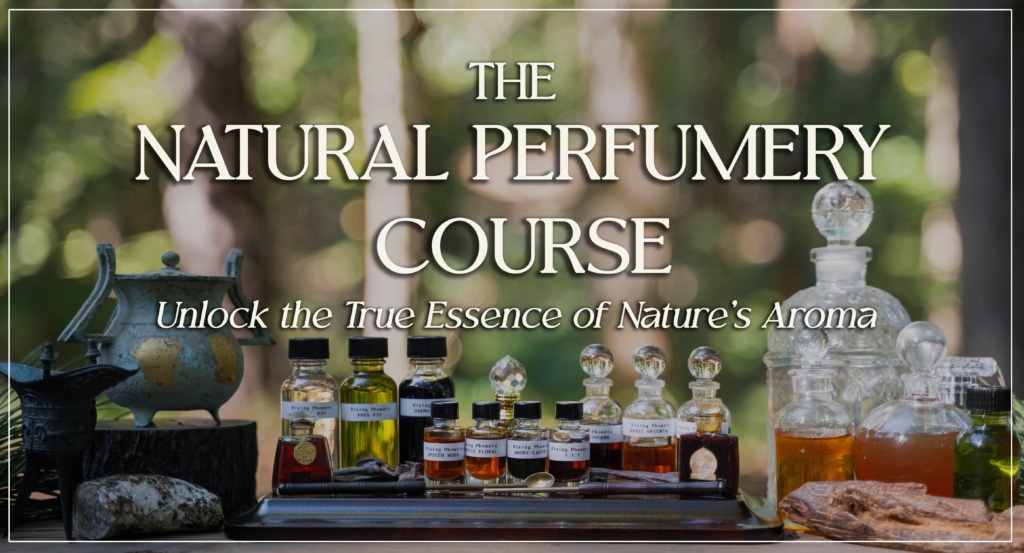
Ready to take your aromatic practice to new heights? Immerse yourself in the art of natural perfumery and learn to create custom, all-natural fragrances – from sprays to attars, solid perfumes, and more – using 100% natural ingredients. Gain the confidence and expertise to design captivating, long-lasting scents for personal enjoyment, luxurious gifts, or even a thriving business. Enrollment opens just once a year – click here to learn more and join the waitlist so you’ll be the first to know when doors open!
Article Written By Melissa Szaro

References
1. Front. Toxicol., 28 August 2025. Sec. Environmental Toxicology. Volume 7-2025. https://doi.org/10.3389/ftox.2025.1646075
© 2026 The Northwest School of Aromatic Medicine. All rights reserved.
*The statements above have not been evaluated by the FDA, and are for educational purposes only. This article is not intended to diagnose, treat, cure, or prevent any disease. This article should not be taken as medical advice. Please consult your physician before you use this information for health purposes.
